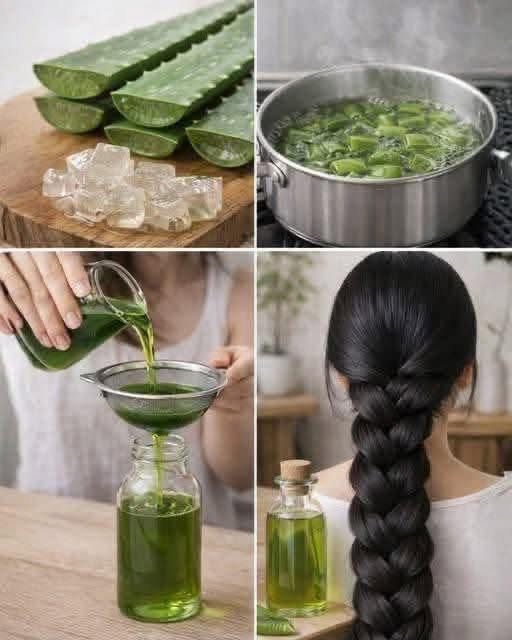
🌿✨ How to Make Aloe Vera Oil for Healthier-Looking Hair — A Simple DIY Scalp and Hair Treatment
Have you seen social-media posts claiming that homemade aloe vera oil can make hair grow dramatically faster?
Aloe vera has long been used in skin and hair-care routines because its gel feels cooling, lightweight, and moisturizing. This homemade treatment may help soften dry hair, reduce the feeling of scalp dryness, and make hair look smoother and shinier.
However, there is currently no strong clinical evidence proving that homemade aloe vera oil makes human hair grow faster or reverses medical hair loss.
Think of this recipe as a moisturizing hair and scalp treatment—not as a guaranteed hair-growth cure.
The safest homemade method is to prepare a small batch for immediate use. Fresh aloe gel contains water, so mixing it into oil and storing it for weeks can allow contamination or spoilage.
⏱️ Preparation Time: 10 minutes
🔥 Heating Time: 10–15 minutes
❄️ Cooling Time: 20 minutes
🧴 Yield: Approximately ¼ cup
📅 Best Use: Prepare fresh and use the same day
Ingredients
- 2 tablespoons clear aloe vera gel
- ¼ cup coconut oil, jojoba oil, or extra-virgin olive oil
- 2–3 drops rosemary essential oil, optional
- 2 drops lavender essential oil, optional
Best Carrier-Oil Options
Coconut Oil: Rich and conditioning, especially for dry or coarse hair. It may feel too heavy on fine or oily hair.
Jojoba Oil: Lightweight and often easier to use on the scalp without leaving hair extremely greasy.
Olive Oil: Thick, moisturizing, and useful for very dry hair, but it may require more shampoo to remove.
Argan Oil: Lightweight and especially useful on dry ends, although it is usually more expensive.
Important Aloe Preparation
Use only the clear inner gel of the aloe leaf.
Do not use the yellow liquid found directly underneath the green outer skin. This yellow material is commonly called aloe latex and can be irritating.
When using a fresh aloe leaf:
- Wash the leaf thoroughly.
- Cut off the bottom end.
- Stand the leaf upright in a bowl for approximately 10–15 minutes so the yellow liquid can drain.
- Rinse the leaf again.
- Carefully remove the green outer skin.
- Scoop out only the transparent gel.
- Rinse the clear gel before using.
You can also use commercially prepared pure aloe vera gel, but check the label and avoid products containing strong fragrance, artificial color, or numbing ingredients.
Instructions
1. Blend the Aloe Gel
Place 2 tablespoons of clear aloe vera gel in a small blender or food processor.
Blend until smooth and free of large pieces.
When using fresh aloe, the gel may become slightly foamy after blending. This is normal.
2. Combine the Aloe and Carrier Oil
Add the aloe gel and your selected carrier oil to a small saucepan.
Stir until the aloe is distributed through the oil.
Fresh aloe gel and oil do not naturally remain blended because one contains water and the other contains fat. Some separation is expected.
3. Heat Gently
Place the saucepan over the lowest possible heat.
Warm the mixture for approximately 10–15 minutes, stirring frequently.
Do not deep-fry the aloe or allow the oil to smoke.
The goal is to warm the mixture gently and reduce some moisture—not to burn the gel.
Remove it from the heat when the bubbling has reduced and the aloe pieces appear smaller or lightly cooked.
4. Cool Completely
Set the saucepan aside and let the mixture cool completely.
Never apply hot oil to your hair or scalp.
5. Strain the Oil
Pour the cooled mixture through a fine-mesh strainer or several layers of clean cheesecloth.
Strain it into a clean, dry bowl.
Discard the remaining aloe solids.
Because homemade equipment cannot confirm that every drop of water has been removed, this small-batch preparation should not be treated as a shelf-stable cosmetic oil.
6. Add Optional Essential Oil
When using rosemary or lavender essential oil, add only a few drops after the mixture has cooled.
For approximately ¼ cup of carrier oil, keep the total amount to about 2–3 drops for a gentle first-time preparation.
Essential oils are highly concentrated and should never be applied directly to the scalp without dilution.
Skip them completely when you have sensitive skin, allergies, eczema, scalp irritation, or a history of reactions to fragranced products.
How to Apply Aloe Vera Oil
For the Scalp
Part dry or slightly damp hair into several sections.
Apply a small amount of the mixture to the scalp using clean fingertips.
Massage gently for approximately 3–5 minutes.
Use light pressure. Aggressive rubbing or scratching can irritate the scalp and contribute to hair breakage.
Leave the treatment on for 20–30 minutes.
Wash thoroughly with a gentle shampoo.
A second shampoo may be necessary when using coconut or olive oil.
For Dry Hair
Apply a small amount from the mid-lengths to the ends.
Avoid coating the roots heavily when your hair becomes oily easily.
Leave it on for 20–30 minutes, then shampoo and condition normally.
As a Pre-Shampoo Treatment
Apply the oil before washing your hair.
Cover the hair loosely with a shower cap and leave it for up to 30 minutes.
Do not leave a fresh aloe-and-oil preparation on overnight, especially during the first use.
How Often Can You Use It?
Start with once a week.
When your scalp tolerates it well, you may use it up to twice weekly.
Using more oil does not make hair grow faster. Excessive use may cause buildup, greasy hair, clogged pores around the hairline, or scalp irritation.
The American Academy of Dermatology notes that oils in hair-care products can contribute to small breakouts around the forehead and hairline in some people.
Always Perform a Patch Test
Before applying the treatment across your entire scalp:
- Place a small amount behind the ear or on the inner forearm.
- Leave it for the same amount of time you plan to use it on your scalp.
- Wash the area.
- Watch for redness, itching, burning, swelling, or a rash over the next 24 hours.
Do not use the mixture when irritation develops.
Topical aloe gel is generally well tolerated, but burning, itching, rash, and eczema have occasionally been reported.
Important Storage Warning
Fresh aloe gel contains water.
Water introduced into homemade oil can support microbial growth, even when the product looks or smells normal.
For that reason:
- Prepare only a small amount.
- Use it the same day.
- Do not leave it at room temperature for later use.
- Do not keep it in the bathroom.
- Do not assume heating makes it permanently shelf-stable.
- Discard leftovers rather than storing them for several weeks.
For a longer-lasting option, purchase a professionally formulated aloe-infused cosmetic oil that includes appropriate preservation and stability testing.
The FDA explains that homemade cosmetics must still be safe under their labeled or customary conditions of use, even though most cosmetic ingredients do not receive premarket FDA approval.
Faster No-Heat Method
For one immediate application, combine:
- 1 tablespoon pure aloe vera gel
- 1 tablespoon jojoba or coconut oil
Whisk or shake immediately before use.
Apply the freshly mixed treatment to the scalp and hair, leave it on for 20 minutes, and shampoo thoroughly.
Discard any leftover mixture.
This version will separate naturally and should not be stored.
Aloe and Coconut Oil Treatment
Combine:
- 2 tablespoons aloe gel
- 2 tablespoons melted coconut oil
This richer version is best for dry, coarse, curly, or chemically treated hair.
Apply mainly to the lengths and ends when your scalp becomes oily easily.
Aloe and Jojoba Scalp Treatment
Combine:
- 2 tablespoons aloe gel
- 2 tablespoons jojoba oil
Jojoba oil has a lighter texture than coconut or olive oil and may be easier to rinse from fine hair.
Aloe and Argan Oil Treatment
Combine:
- 2 tablespoons aloe gel
- 1 tablespoon argan oil
Apply mainly to dry or frizzy lengths.
Use only a small amount near the roots.
What This Treatment May Do
Depending on your hair and scalp type, it may help:
- Add temporary softness
- Reduce the appearance of dry, rough ends
- Make hair look shinier
- Reduce friction during detangling
- Soothe the feeling of mild dryness
- Support a gentler scalp-care routine
The American Academy of Dermatology describes aloe vera as a lightweight ingredient that can soothe and moisturize skin.
What It Has Not Been Proven to Do
Homemade aloe oil has not been proven to:
- Make hair grow several inches in days
- Cure alopecia
- Permanently stop hair loss
- Regrow hair on a bald area
- Treat scalp infections
- Replace prescribed hair-loss treatment
- Repair permanently damaged hair follicles
Products marketed with claims such as “hair restoration” or treatment of medical conditions may be making drug claims rather than ordinary cosmetic claims. The FDA has previously issued warning letters involving unsupported hair-restoration and aloe-related treatment claims.
When to See a Dermatologist
Schedule a medical evaluation when you notice:
- Sudden or rapid hair loss
- Circular bald patches
- A widening part
- A receding hairline
- Pain, burning, sores, or heavy scaling
- Hair breaking close to the scalp
- Significant shedding lasting several months
- Hair loss after starting a medication
- Hair loss accompanied by fatigue, weight change, or other symptoms
Hair loss has many possible causes, and the correct treatment depends on the diagnosis. The American Academy of Dermatology provides condition-specific guidance because different types of hair loss require different treatment approaches.
Healthy-Hair Tips That Matter More Than Viral Oils
For healthier-looking hair:
- Avoid consistently tight braids, buns, or ponytails.
- Reduce excessive heat styling.
- Use conditioner after shampooing.
- Detangle gently, beginning at the ends.
- Avoid aggressively rubbing wet hair with a towel.
- Eat enough protein and a balanced diet.
- Treat ongoing dandruff or scalp irritation properly.
- Seek professional advice for unexplained shedding.
Frequently Asked Questions
Can I Leave Aloe Vera Oil on Overnight?
It is better to begin with a 20- to 30-minute treatment.
Fresh aloe-and-oil mixtures can be messy, may irritate sensitive skin, and should not be stored or left on for extended periods during the first use.
Can I Apply It Every Day?
Daily use is unnecessary and may create buildup.
Start once weekly and adjust according to how your scalp and hair respond.
Can I Add Onion Juice?
Mixing multiple fresh, water-based ingredients increases odor, irritation risk, and preservation problems.
It is better to keep the recipe simple and prepare only enough for one use.
Can I Add Vitamin E?
A small amount of cosmetic-grade vitamin E can be added, but vitamin E is not a reliable preservative and will not make a fresh aloe-and-oil mixture shelf-stable.
Can I Use Aloe Straight from the Plant?
Yes, but drain and rinse away the yellow latex, use only the clear inner gel, perform a patch test, and prepare only enough for immediate use.
Will It Grow Hair Faster?
There is no strong evidence that aloe oil speeds human hair growth.
It may support a moisturizing routine and improve the way dry hair looks or feels, but genuine hair-growth concerns should be assessed according to their underlying cause.
The Bottom Line
Homemade aloe vera oil can be a simple moisturizing pre-shampoo treatment for dry hair and scalp.
It may leave the hair feeling softer and looking shinier, but it should not be promoted as a guaranteed solution for rapid hair growth or medical hair loss.
Prepare it fresh, patch-test first, rinse it out thoroughly, and stop using it when irritation occurs.
📌 Save this DIY treatment for your next self-care day.
👇 Which carrier oil would you choose—coconut, jojoba, olive, or argan oil? Tell us in the comments!
#AloeVeraOil #HairCareRoutine #DIYHairCare #AloeVeraForHair #NaturalHairCare #ScalpCare #HealthyLookingHair #HairOil #PreShampooTreatment #DryHairCare #HairCareTips #SelfCareRoutine #HomemadeBeauty #BeautyTips #HairCare