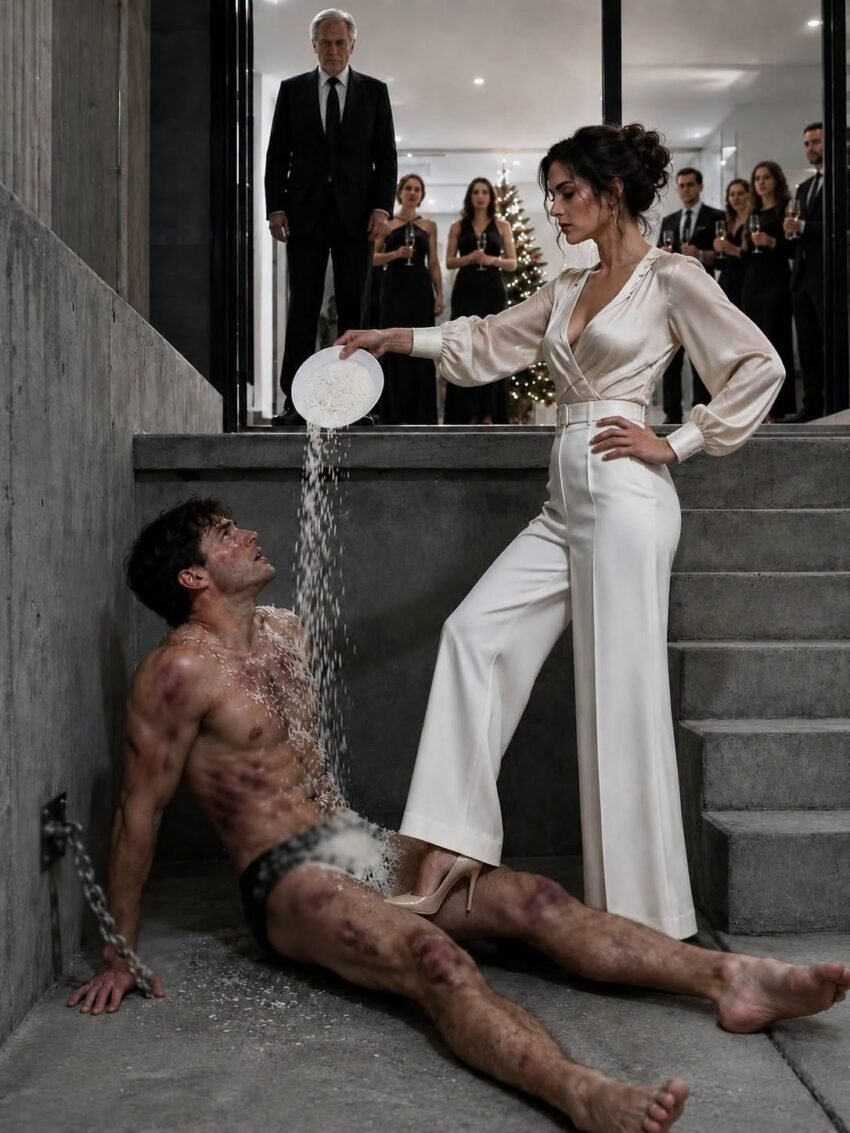
Found My Son Chained in His Own Basement on New Year’s Eve — Part 2
Upstairs, everyone began counting down to midnight.
Downstairs, I captured every word that would bring their entire world crashing down.
My daughter-in-law, Vanessa, stood over my son with a plate of untouched food in one hand and a champagne flute in the other.
She looked perfect.
That was the part that made my skin crawl.
Her silver dress glittered under the weak basement bulb. Her hair was pinned beautifully. Her makeup was flawless. She looked like the kind of woman guests upstairs would describe as graceful, generous, elegant.
But the smile she gave my son was empty.
Cold.
Practiced.
“Happy New Year, sweetheart,” she said softly.
My son, Michael, lay against the concrete pillar, breathing shallowly. His face was bruised. His lips were dry. His hands trembled against the chain around his wrist.
“Vanessa,” he whispered. “Please.”
She crouched in front of him and tilted her head.
That little gesture nearly broke me.
I had seen her do it before.
At family dinners.
At charity events.
At my wife’s funeral.
Whenever she wanted people to think she was sweet.
“You should have signed when Daddy asked nicely,” she said.
Daddy.
Her father.
Richard Vale.
The man upstairs in a black tuxedo, laughing with judges, investors, bankers, and politicians while my son was chained beneath his own home.
My phone shook in my hand.
I forced myself to keep recording.
Michael’s eyes flicked toward the dark corner where I stood.
Only for half a second.
But it was enough.
He knew I was there.
He knew I had not left him.
Then his face went blank again, as if even hope was too dangerous to show.
Vanessa set the plate on the floor just beyond his reach.
“You always were stubborn,” she said. “That was attractive at first. A self-made man. A builder. A fighter. But then you started forgetting your place.”
Michael swallowed.
“My place?”
“Beside me,” she said. “Not above me.”
She leaned closer.
“This house, your accounts, the development company, the trust your father helped build—everything should have been ours. But you kept everything locked behind lawyers and signatures.”
My chest tightened.
She was right about that part.
Years earlier, when Michael started doing well, I had begged him to protect himself.
Not because I distrusted marriage.
Because I had spent my life in construction and business, and I knew exactly how quickly love could become leverage when the wrong person saw a balance sheet.
Michael had laughed at me back then.
“Dad, Vanessa loves me.”
I had said, “Then she won’t mind the documents.”
She had minded.
Quietly.
Beautifully.
Dangerously.
Vanessa took a slow sip of champagne.
“You made Daddy look like a fool,” she said.
Michael’s voice was barely audible.
“Your father tried to steal from my company.”
“He tried to help expand it.”
“He forged vendor approvals.”
Vanessa’s smile vanished.
“Careful.”
“He moved money through shell accounts.”
She struck the plate with her shoe, sending food across the floor.
“Still acting righteous from the ground?”
Upstairs, the countdown grew louder.
Ten!
Guests shouted with excitement.
Vanessa glanced toward the ceiling.
“Perfect timing,” she said.
Then another set of footsteps came down the stairs.
Heavy.
Slow.
Confident.
Richard Vale appeared at the bottom, adjusting his cufflinks.
He was a broad man in his late sixties, with silver hair and the smooth face of someone who had spent his life making other people carry stress for him.
“Vanessa,” he said sharply, “why is he still conscious?”
My stomach turned.
Vanessa rolled her eyes.
“He’s useful conscious.”
Richard stepped closer to Michael.
“My boy,” he said, voice full of false warmth. “You could have made this so easy.”
Michael stared at him.
“You’re going to prison.”
Richard laughed.
“Michael, there are thirty-eight people upstairs. Half of them owe me favors. The other half owe me money.”
He crouched slowly.
“You think anyone will believe you over my daughter? Over grieving little Vanessa, who found her troubled husband after he tragically relapsed?”
Michael closed his eyes.
Richard continued.
“You have the medical history. The old injury. The pain medication after surgery. The stress. The depression after losing your mother. It writes itself.”
My whole body went cold.
My wife.
Michael’s mother.
She had died two years earlier, and Michael had never been the same.
He had hidden the grief under work, but I knew my son.
Vanessa had known too.
And she had planned to use it.
Upstairs:
Five! Four! Three!
Richard pulled papers from inside his jacket and threw them onto Michael’s chest.
“Last chance. Sign the transfer authorization. Sign the revised trust access. Sign the company voting rights. Then maybe my daughter calls help before things become irreversible.”
Michael looked at the papers.
Then at Vanessa.
“You were never going to let me live.”
Vanessa said nothing.
That silence was the confession.
Two! One!
The guests upstairs erupted.
“HAPPY NEW YEAR!”
Music exploded through the house.
Cheers.
Laughter.
Kissing.
Celebration.
Downstairs, Richard grabbed Michael by the jaw.
“Sign.”
My finger hovered over my phone screen.
Recording.
Still recording.
I knew I had enough.
Enough to prove intent.
Enough to prove motive.
Enough to prove what they had done and what they planned to do.
But enough evidence did not free my son from the chain.
I needed seconds.
Just seconds.
Richard stood and turned to Vanessa.
“Get the attorney downstairs.”
Vanessa frowned.
“Now?”
“Yes. I want this finished before sunrise.”
She hesitated.
“What about the guests?”
“Keep smiling.”
She stepped toward the stairs.
That was when Michael suddenly spoke.
“Dad.”
The word cut through the basement like thunder.
Vanessa froze.
Richard froze.
So did I.
For one terrible second, nobody moved.
Then Vanessa turned slowly toward the shadows.
“What did you say?”
Michael lifted his head, weak but deliberate.
“I said Dad.”
Richard’s face changed.
Not fear yet.
Calculation.
He looked toward the dark side of the basement.
“Who’s there?”
I stepped out of the shadows with my phone still raised.
“His father.”
Vanessa’s champagne glass slipped from her hand and shattered on the floor.
Richard recovered faster.
“Mr. Turner,” he said smoothly. “This is not what it looks like.”
I looked at my son.
Then at the chain.
Then at the papers.
Then at Richard.
“You’re going to need a better sentence than that.”
Vanessa backed up toward the stairs.
“Dad…”
Richard lifted one hand at her.
“Stay calm.”
I kept the phone aimed at them.
“I’ve been recording.”
Richard’s eyes flicked to the phone.
Just once.
But I saw the fear land.
“You are trespassing,” he said.
I almost laughed.
“This is my son’s house.”
“Not for long.”
That was a stupid thing to say while being recorded.
He realized it a second too late.
Vanessa pointed at Michael.
“He’s unstable. He attacked us. We had to restrain him.”
I looked at her.
“You drove your heel into a man who was already chained to a pillar.”
Her mouth opened.
No answer.
Richard took one slow step toward me.
“Turn off the phone, and we can discuss this like men.”
I had known men like Richard my whole life.
Men who called bribery discussion.
Threats negotiation.
Violence discipline.
“No.”
His face hardened.
“You don’t understand who I am.”
“No,” I said. “You don’t understand who I called before I came downstairs.”
That stopped him.
Because before entering the basement, before finding Michael, before turning on my camera, I had done one thing.
I had called my attorney.
Not 911 first.
Not because I didn’t want police.
Because I knew Richard Vale had friends everywhere, and I needed the truth stored somewhere he could not reach.
The call was still open in my coat pocket.
Muted.
Recording.
Streaming.
My attorney, Naomi Pierce, had heard everything.
And by then, she had already contacted the state police investigator she trusted.
Sirens sounded in the distance.
Faint at first.
Then closer.
Vanessa turned white.
“No,” she whispered.
Richard moved fast.
He lunged for my phone.
But I was not a young man.
I was not a weak man either.
I had built houses with my own hands for forty years. I had carried lumber through rain, climbed scaffolding with broken ribs, pulled grown men out of collapsed foundations.
Richard Vale had spent his life ordering other people to sweat.
When he grabbed my wrist, I drove my shoulder into his chest and slammed him back against the wall.
He hit the concrete hard enough to lose his breath.
Vanessa screamed.
Michael shouted, “Dad!”
The basement door opened above us.
A guest’s voice called down.
“Vanessa? Is everything okay?”
Vanessa looked up at the stairs.
Then at me.
Then at Michael.
For one second, I thought she might run.
Instead, she did what people like her always do.
She performed.
She screamed toward the stairs, “Help! He’s attacking my father!”
Several guests rushed down.
The first was a man in a tuxedo holding a party horn.
He stopped halfway down the stairs when he saw Michael.
His face went blank.
More people crowded behind him.
A woman gasped.
Someone whispered, “Oh my God.”
Vanessa tried to push past them.
“My husband had an episode,” she cried. “My father was helping me. His father attacked us.”
I raised my phone.
“Then let’s play the video.”
She froze.
Richard, still against the wall, coughed and said, “Do not let him—”
But the guests had already seen enough.
The chain.
The papers.
Michael’s condition.
The needle marks.
The shattered glass.
The plate on the floor.
Some truths do not need narration.
A man near the stairs pulled out his own phone.
Then another.
Then another.
For the first time that night, Vanessa lost control of the audience.
I turned to the nearest guest.
“Call 911 again. Tell them an injured man is chained in the basement.”
A woman in a green dress was already crying into her phone.
“They’re coming,” she said. “Police are coming.”
Richard tried to stand.
Two men blocked him.
He glared at them.
“You don’t know what you’re involving yourselves in.”
One of them looked at Michael and said, “I know enough.”
Vanessa sank onto the bottom stair, trembling.
Not from remorse.
From the sudden understanding that the stage had changed and she was no longer directing the scene.
I went to Michael.
The chain was wrapped around the pillar and locked with a thick padlock.
“Key?” I demanded.
No one answered.
I looked at Vanessa.
“Where is the key?”
She stared at the floor.
I stepped toward her.
“Where is the key?”
Richard snapped, “Don’t answer.”
Vanessa began to cry.
Real tears maybe.
Fake tears maybe.
I no longer cared.
“In the laundry room,” she whispered. “Top cabinet. Red box.”
One of the guests ran upstairs.
I knelt beside Michael.
His hand found mine.
He gripped it like he was a little boy again.
“Dad,” he whispered.
“I’m here.”
“I told you not to come.”
“I’ve never listened well.”
His mouth twitched.
It might have been a smile.
Then his eyes filled.
“I thought I was going to die down here.”
Something inside me broke.
But I could not break yet.
Not while he still needed me.
“You’re not dying tonight.”
The guest returned with the key.
My hands shook as I unlocked the chain.
When the metal fell away from Michael’s wrist, he made a sound I will never forget.
Not relief exactly.
Something deeper.
A body realizing it belongs to itself again.
The police arrived moments later.
Then paramedics.
Then more officers.
The party upstairs emptied into chaos.
People gave statements in evening gowns and tuxedos while champagne sat untouched on silver trays.
The giant clock above the entryway read 12:19 a.m.
Nineteen minutes into the new year, and the Vale family’s perfect world had already begun collapsing.
Paramedics stabilized Michael carefully.
When they moved him, he gritted his teeth so hard I thought he would pass out.
I walked beside the stretcher.
Vanessa suddenly stood.
“Michael,” she sobbed. “Tell them this is a misunderstanding.”
Michael turned his head.
For the first time since I arrived, he looked directly at her without fear.
“No.”
One word.
That was all.
But it landed harder than any speech.
Police took Vanessa and Richard separately.
Richard demanded his lawyer.
Vanessa demanded her father.
Neither demand sounded powerful anymore.
At the hospital, doctors worked on Michael for hours.
His knee needed major surgery.
His system showed medication he had not willingly taken.
His wrists were bruised from restraints.
He had dehydration, infection risk, and injuries old enough to prove this had not begun that night.
When the doctor told me that, I had to sit down.
Not because I was surprised.
Because I was a father.
And fathers are supposed to know when their sons are being destroyed.
I thought of the message from a week earlier.
Dad… don’t come. If you walk through that door, they’ll kill you.
I had spent seven days trying to be careful.
Calling.
Driving past.
Checking public records.
Speaking to Naomi.
Trying not to rush in and make things worse.
Now I wondered if caution had cost my son more pain.
Naomi arrived at the hospital at 3:00 a.m.
She was still in her New Year’s Eve dress under a winter coat.
Her hair was messy. Her eyes were sharp.
“I sent copies of everything to three places,” she said before I asked. “Local police, state investigators, and a federal contact tied to financial crimes.”
“Financial crimes?”
She looked at me.
“Richard Vale was not only trying to kill your son. He was trying to take control of the company first. That makes the paperwork important.”
I closed my eyes.
The company.
Michael’s company.
The home.
The trust.
The transfer documents.
They had wanted him to sign over everything before staging his death.
A clean inheritance.
A grieving widow.
A powerful father-in-law to manage the money.
A dead husband with a history of pain medication.
It was monstrous.
It was also organized.
That meant we had to be more organized.
By morning, the first arrests were official.
Vanessa Vale Turner.
Richard Vale.
One private nurse who had supplied medication.
One security consultant who helped disable parts of the camera system.
And a family attorney who had drafted the transfer papers and claimed he “didn’t know the circumstances.”
Nobody believed him for long.
The video changed everything.
My phone had captured Vanessa’s words.
Richard’s threats.
The documents.
The plan.
The mention of overdose.
The demand to sign.
Their entire beautiful lie, spoken aloud beneath a party where guests were drinking champagne over my son’s suffering.
Within forty-eight hours, the story reached the press.
I did not give interviews.
Neither did Michael.
Naomi gave one statement:
Mr. Turner is alive, receiving medical care, and cooperating with investigators. The family asks for privacy while legal proceedings continue.
That did not stop the headlines.
NEW YEAR’S PARTY HIDES HORROR IN BASEMENT
WIFE AND FATHER ACCUSED IN PLOT AGAINST BUSINESSMAN HUSBAND
GUESTS COUNTED DOWNSTAIRS WHILE ALLEGED CRIME UNFOLDED BELOW
People became obsessed.
They wanted details.
They wanted pictures.
They wanted to know how a woman could smile upstairs while her husband was chained below.
I wanted them to stop asking like it was entertainment.
Because Michael was not a headline.
He was my son.
For five days, he drifted between pain, sleep, and moments of panic.
Sometimes he woke gripping the hospital sheets, whispering, “Don’t let them take me back.”
Every time, I said the same thing.
“You are safe. I am here. They are gone.”
At first, he did not believe me.
Then he wanted to.
Then slowly, his body began to understand.
The first real conversation happened on the sixth day.
He was awake, pale, exhausted, his leg immobilized, machines humming softly around him.
I sat beside him.
For a long time, we said nothing.
Then he whispered, “I was embarrassed.”
I looked at him.
“Of what?”
His eyes filled.
“That I let it happen.”
I leaned forward.
“Michael.”
“I’m serious, Dad. I built companies. I negotiated with men twice my age. I survived Mom dying. I thought I was strong.”
“You are strong.”
He shook his head.
“She isolated me so slowly I didn’t notice. First she said you were controlling. Then she said my friends used me. Then her father started advising me on business. Then documents changed. Then money moved. Then I asked questions and everything became punishment.”
His breathing changed.
I placed a hand on his shoulder.
“You don’t have to tell it all now.”
“I need to.”
So I listened.
He told me how Vanessa began by managing his medication after a knee injury months earlier.
How she convinced him he was dependent.
How Richard told him investors were losing confidence.
How they argued more often.
How his phone disappeared.
How staff were replaced.
How a doctor Vanessa knew prescribed things that made him foggy.
How, by Christmas, he realized money had been moved and signatures forged.
When he threatened to call me, they took him downstairs.
My hands clenched into fists.
Michael saw.
“Dad.”
“I’m okay.”
“No, you’re not.”
He was right.
But this was not about me.
He looked toward the window.
“I sent that message when they forgot my phone in the basement.”
“How?”
“Voice command. It barely worked. I thought if I warned you away, at least you’d survive.”
I bowed my head.
My son had been chained and injured, and he had still been trying to protect me.
“I’m sorry,” I said.
His eyes moved back to me.
“For what?”
“For not breaking the door down the first day.”
He swallowed.
“If you had, Richard might have been ready.”
“Maybe.”
“You came when you could win.”
I looked at him.
He said it again, weaker but certain.
“You came when you could win.”
That was the first bit of peace I allowed myself.
Weeks passed.
Michael had two surgeries.
Then physical therapy began.
The doctors were honest: his knee would never be exactly the same.
He might walk with pain.
He might need more procedures.
He might carry reminders of that basement for the rest of his life.
He listened quietly.
Then asked, “Will I walk?”
The surgeon said, “With work, yes.”
Michael nodded.
“Then we work.”
That was my son.
Hurt.
Shaken.
Changed.
But still there.
The legal case grew bigger.
Investigators found that Richard Vale had targeted more than my son’s assets.
He was already under quiet scrutiny for investment fraud, charity diversion, and pressure tactics against business partners.
Vanessa had not been an innocent daughter dragged into her father’s plan.
She had been an active part of it.
Emails showed her complaining that Michael was “becoming difficult.”
Texts showed her asking how long certain medications would affect memory.
A message to her father read:
Once he signs, we don’t need him coherent anymore.
That line haunted me.
When Naomi read it aloud, Michael closed his eyes.
I saw the last piece of love die in him.
Not love for who Vanessa was.
Maybe love for who he wished she had been.
There is grief even in surviving betrayal.
People forget that.
They think once the villain is exposed, the victim should feel only relief.
But Michael had married her.
He had danced with her.
He had planned a family with her.
He had kissed her goodbye on mornings when she was already planning his end.
Survival does not erase the humiliation of having loved someone who saw you as a document to be signed.
Three months later, Michael came home from the rehabilitation center.
Not to the old house.
Never again.
We sold it during the investigation, with court approval and full documentation.
He moved into my guest house temporarily.
I had built it years earlier for visiting family.
Now I added ramps, rails, cameras, and too many motion lights because fear makes fathers excessive.
Michael noticed but said nothing at first.
On the fourth night, he sat on the porch with his cane beside him.
“You put a camera facing the birdbath.”
“Birds are suspicious.”
He laughed.
It was small.
Rusty.
Real.
I had not heard that sound in months.
I almost cried.
He saw that too.
“Dad.”
“What?”
“Don’t.”
“I wasn’t.”
“You were.”
I looked out at the yard.
“Your mother would have handled this better.”
“No,” he said softly. “She would have burned down the whole city.”
That time, I laughed.
And cried a little.
He let me.
The trial took nearly a year.
Vanessa changed lawyers twice.