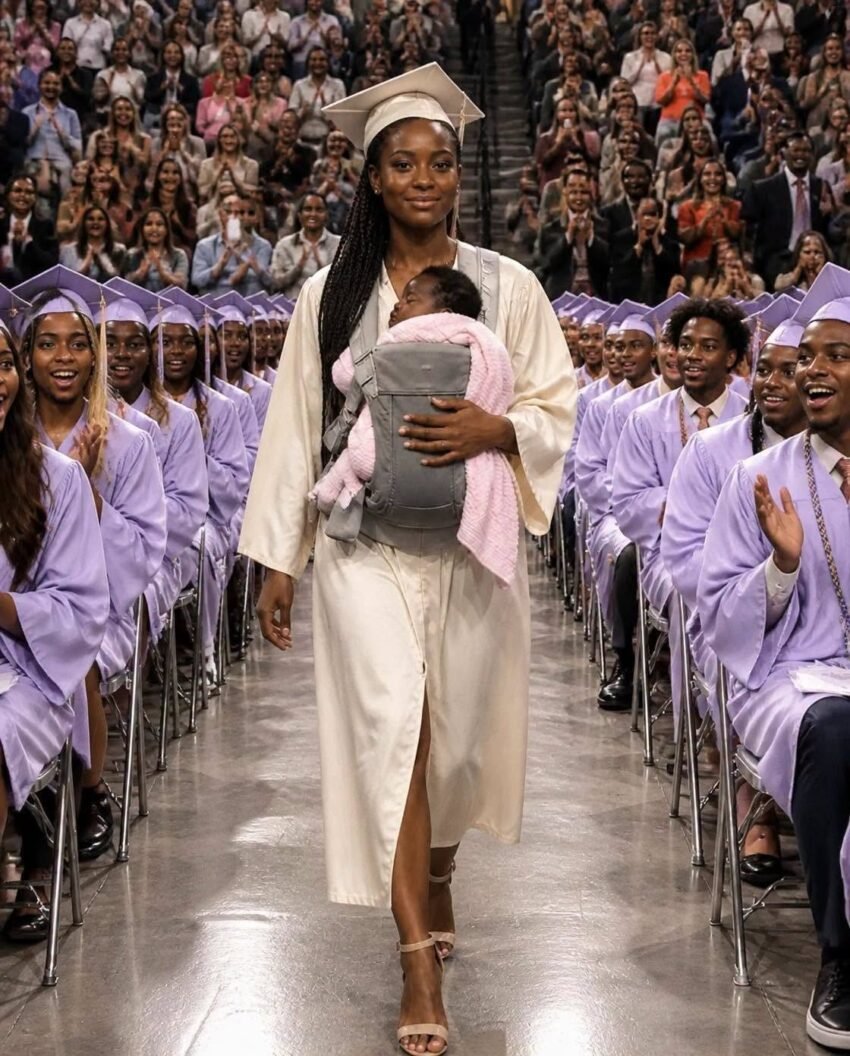
They Laughed When My Daughter Walked Across the Graduation Stage Holding a Newborn — But Her Speech Silenced the Entire Room
They started laughing the moment my daughter walked onto the graduation stage with a newborn in her arms.
At first, it was only a few whispers.
Then came the little cruel chuckles people try to hide behind their hands.
Someone sitting behind me muttered, “Just like his mother…”
My hands curled into fists in my lap.
Because I knew exactly what they meant.
They were talking about me.
Eighteen years earlier, I had walked across a different stage while pregnant with my daughter, Emily. I was seventeen then, scared, exhausted, and wearing a borrowed white dress that barely fit over my belly.
People whispered about me too.
They said I had ruined my life.
They said my parents should be ashamed.
They said no decent future could come from a girl like me.
But I kept going.
I graduated.
I worked nights.
I raised my baby alone after her father disappeared before she was born.
And that baby grew into the young woman now standing on the stage in front of the entire auditorium.
Emily was wearing her cap and gown.
In her arms was a newborn wrapped in a pale yellow blanket.
My granddaughter.
Little Grace.
Only three weeks old.
Emily held her carefully against her chest as she walked toward the microphone.
The laughter grew louder.
I saw one mother lean toward another and smirk.
A group of boys near the back covered their mouths.
Even one teacher looked uncomfortable, as if Emily had brought something shameful onto the stage instead of a sleeping baby.
My daughter heard all of it.
I saw it in the way her shoulders tightened.
But she did not stop.
She reached the microphone.
The principal cleared his throat awkwardly.
“Emily, are you sure you want to—”
“Yes,” she said.
Her voice was calm.
Not loud.
Not angry.
Just steady.
The room quieted a little.
Emily adjusted the baby in her arms and looked out at the crowd.
“I know some of you are laughing,” she said.
The auditorium went still.
My heart dropped.
I wanted to run onto that stage and shield her from every cruel face in the room.
But Emily kept speaking.
“I know what you see when you look at me. You see a teenage mother. You see a mistake. You see a warning story. You see someone you think should be embarrassed.”
She looked down at Grace.
Then back at the audience.
“But this baby is not my shame.”
A silence fell so deep I could hear the soft hum of the lights above us.
Emily continued.
“Her name is Grace. She is my daughter. And yes, I became a mother before I planned to. Yes, my life changed. Yes, I cried in bathrooms, studied while she kicked inside me, worked weekend shifts until my feet were swollen, and finished assignments while everyone else was sleeping.”
Her voice shook, but she did not break.
“But I am standing here today with a 4.0 GPA, a college scholarship, and an acceptance letter to nursing school.”
A few people gasped.
My eyes filled with tears.
She had not told anyone about the scholarship yet.
Not even most of our family.
Emily looked toward the rows of students behind her.
“And I want to say something to every girl who has ever been laughed at for surviving something hard. People will call you a mistake when they are too lazy to understand your strength. They will use your hardest season as your whole identity. But you are not the worst thing people think they know about you.”
I covered my mouth.
Because those were words I had needed to hear eighteen years ago.
Emily turned her eyes toward my section.
For a moment, she looked directly at me.
“My mother was seventeen when she had me.”
The woman behind me shifted in her seat.
Emily’s face softened.
“People laughed at her too. They told her she had ruined her future. But she raised me while working two jobs. She went hungry so I could eat. She studied after twelve-hour shifts. She taught me that love is not proven by perfect timing. Love is proven by staying when life becomes difficult.”
Tears rolled down my face.
I could no longer hold them back.
Emily swallowed hard.
“So when someone says, ‘Just like her mother,’ I take that as a compliment.”
The entire room froze.
The person behind me stopped breathing for a second.
Emily smiled faintly.
“Because if I am anything like my mother, then my daughter is going to be just fine.”
For one second, there was nothing.
No whispering.
No laughter.
No movement.
Then someone clapped.
It was an older man near the front row.
Then a teacher.
Then another parent.
Then half the auditorium.
Then the whole room.
The applause rose so loudly that Grace stirred in Emily’s arms.
Emily looked down and laughed through tears.
I stood before I realized I had moved.
My hands were shaking as I clapped.
Soon everyone around me was standing too.
Everyone except the woman behind me.
I did not turn around.
I didn’t need to.
Emily had already answered her better than I ever could.
After the ceremony, people rushed toward my daughter.
Some congratulated her.
Some apologized.
Some pretended they had never laughed at all.
Emily handled it with more grace than I would have.
She thanked them politely, kissed her baby’s forehead, and walked straight toward me.
The second she reached me, I pulled her into my arms.
Carefully, because of Grace.
But tightly enough that she knew I meant it.
“You were incredible,” I whispered.
Emily’s face crumpled.
“Were you embarrassed?”
I pulled back and looked at her.
“Embarrassed?”
She nodded, tears filling her eyes.
“When they laughed, I thought maybe I shouldn’t have brought her up there. I thought maybe I made things harder for you.”
I touched her cheek.
“Emily, you did not embarrass me. You honored me.”
She started crying then.
Not the quiet tears from the stage.
Real ones.
The kind she had held back for months.
“I was so scared, Mom.”
“I know.”
“I didn’t want to disappoint you.”
“You never did.”
“But I made the same mistake.”
I shook my head.
“No. You had a child young. That is not the same thing as becoming a mistake.”
She looked down at Grace.
“I don’t know if I can do everything.”
“You won’t have to do everything alone.”
Her eyes lifted to mine.
“I don’t want to ruin her life.”
I almost smiled through my tears.
“That’s exactly how I know you won’t.”
Behind us, someone cleared their throat.
I turned and saw the woman who had made the comment behind me.
She was standing with her purse clutched in both hands, her face red.
“I just wanted to say,” she began awkwardly, “I didn’t mean…”
I waited.
Emily waited.
The woman swallowed.
“What I said was unkind. I’m sorry.”
I could have said many things.
I could have told her how words like hers stay with girls for years.
I could have told her that shame does not protect anyone.
I could have told her that I still remembered every whisper from my own graduation day.
But Emily spoke first.
“Thank you for apologizing,” she said.
Then she added, gently but firmly, “Please don’t say that about another girl.”
The woman nodded and walked away.
I stared at my daughter.
“When did you get so wise?”
She gave me a tired smile.
“Probably around the third sleepless night.”
We both laughed.
Grace opened her tiny mouth and yawned.
And just like that, the whole world softened.
Later that evening, we went home.
Not to a fancy dinner.
Not to a big party.
Just home.
I made spaghetti because it was Emily’s favorite, and because when life is overwhelming, pasta usually helps.
Her cap and gown hung over a kitchen chair.
Grace slept in a bassinet beside the table.
Emily’s diploma lay next to a stack of college forms, hospital bills, and scholarship papers.
It was not a perfect scene.
It was messy.
Real.
Beautiful.
Emily sat across from me, exhausted but glowing.
“Do you think nursing school will be too much?” she asked.
“Yes,” I said honestly.
Her face fell.
Then I continued.
“It will be too much some days. Motherhood will be too much some days. Work will be too much some days. But too much does not mean impossible.”
She nodded slowly.
“How did you do it?”
I looked at her for a long moment.
“I didn’t do it all at once. I did one day. Then the next. Then the next.”
She looked down at her daughter.
“I want her to be proud of me.”
“She already will be.”
“She’s three weeks old.”
“Then she’s getting an early start.”
Emily smiled.
That night, after she fell asleep on the couch with Grace curled safely in the bassinet beside her, I sat alone at the kitchen table and opened an old box I had not touched in years.
Inside was my graduation photo.
Me at seventeen.
Pregnant.
Scared.
Trying to smile while people whispered.
For years, I hated that picture.
I saw shame in it.
Struggle.
Loneliness.
But that night, I saw something different.
I saw the beginning of everything I loved most.
I placed Emily’s graduation photo beside mine.
Two young mothers.
Two caps.
Two babies.
Two futures that people thought were over before they had even begun.
But they were wrong then.
And they were wrong now.
The next morning, Emily’s speech had already spread online.
Someone had recorded it and posted it.
The comments came in fast.
Some were kind.
Some were cruel.
That is the way the world is.
But one message stood out.
It was from a woman I did not know.
She wrote:
“I’m seventeen and pregnant. I thought my life was over. Your daughter made me believe I can still become someone.”
I showed it to Emily.
She read it three times.
Then she cried again.
Not because she was hurt.
Because she understood that her courage had traveled farther than the laughter.
Months passed.
Emily started nursing school.
It was hard.
Harder than she expected.
There were days she called me from her car and said, “I can’t do this.”
I always answered the same way.
“You can do today.”
So she did.
One day at a time.
Grace grew.
She learned to smile.
Then crawl.
Then pull herself up on furniture while Emily studied anatomy flashcards on the floor.
Sometimes Emily brought Grace to campus daycare.
Sometimes I watched her.
Sometimes neighbors helped.
Sometimes everything fell apart and we ate cereal for dinner.
But Emily kept going.
Not perfectly.
Faithfully.
And every time she doubted herself, I reminded her of that stage.
The laughter.
The silence.
The applause.
The way she held her daughter and refused to call her shame.
Years later, when Grace was old enough to understand, she found the video of Emily’s graduation speech.
She watched it in our living room, sitting cross-legged on the carpet.
Emily stood behind her, nervous.
When the video ended, Grace turned around with wide eyes.
“Mommy, they laughed at me?”
Emily knelt in front of her.
“No, sweetheart. They laughed because they didn’t understand.”
Grace frowned.
“That was mean.”
“Yes,” Emily said softly. “It was.”
Grace looked at the frozen image on the screen — her mother in a cap and gown, holding her as a newborn.
Then she said, “But you looked brave.”
Emily’s eyes filled.
“I was scared.”
Grace smiled.
“Then you were extra brave.”
I stood in the hallway and quietly wiped my tears.
Because sometimes children understand in one sentence what adults spend years complicating.
Emily did become a nurse.
On the day she pinned her badge to her uniform, she handed Grace to me, stood in front of the mirror, and whispered, “We did it.”
I said, “Yes, you did.”
She shook her head.
“No, Mom. We.”
And maybe she was right.
Because family is not always one person carrying everything.
Sometimes family is three generations learning that shame ends where love tells the truth.
People laughed when my daughter walked across the graduation stage with a newborn in her arms.
They thought they were witnessing failure.
But they were actually witnessing a beginning.
They saw a young mother.
They did not see the nights she studied through tears.
They saw a baby.
They did not see a reason to keep going.
They saw history repeating itself.
They did not understand that sometimes history does not repeat as tragedy.
Sometimes it returns as proof.
Proof that a hard beginning is not the same as an ending.
Proof that a young mother can still build a future.
Proof that a baby can arrive before the plan and still become the blessing that gives the plan new meaning.
And proof that when someone says, “Just like her mother,” the answer can be:
Yes.
Strong like her mother.
Determined like her mother.
Still standing like her mother.
And loved enough to make it through.