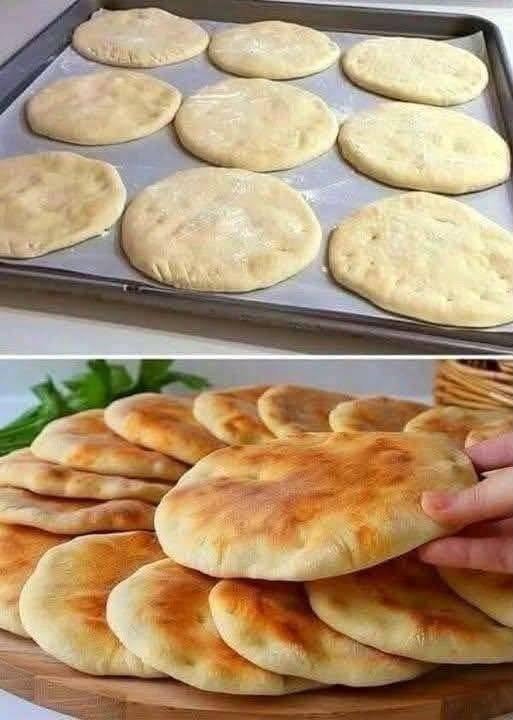
🫓✨ Soft Homemade Skillet Flatbread — Pita Style, Fluffy, Flexible and Made Without an Oven!
There is something incredibly satisfying about watching simple homemade dough puff up into soft, warm flatbread right in a skillet.
This Soft Homemade Skillet Flatbread has lightly golden spots on the outside, a tender and fluffy center, and the flexible texture you want for wraps, sandwiches, dips, and everyday meals.
It is inspired by pita-style bread but cooked entirely on the stovetop, so there is no need to heat the oven or use a baking stone.
Serve it warm with hummus, grilled chicken, kebabs, shawarma, falafel, curries, scrambled eggs, soups, salads, or a simple brushing of melted garlic butter.
The dough uses basic pantry ingredients, and once you learn the simple rolling and skillet technique, you may stop buying packaged flatbread altogether!
⏱️ Prep Time: 20 minutes
⏳ Rising Time: 1–1½ hours
🔥 Cooking Time: 20 minutes
🕒 Total Time: About 2 hours
🍽️ Yield: 8 medium flatbreads
Ingredients
For the Flatbread Dough
- 3 cups all-purpose flour, plus more for rolling
- 2¼ teaspoons active dry yeast, one standard packet
- 1 teaspoon granulated sugar or honey
- 1 teaspoon kosher salt
- 1 cup warm water, approximately 105–110°F
- ¼ cup plain Greek yogurt or regular plain yogurt
- 2 tablespoons olive oil
- 1–3 tablespoons additional warm water, if needed
For Cooking and Finishing
- Olive oil or melted butter, optional
- Flaky salt, optional
- Chopped parsley or cilantro, optional
Why Yogurt Makes the Flatbread Softer
A small amount of plain yogurt adds moisture and tenderness to the dough.
It also gives the bread a very light tang and helps it remain flexible after cooling.
Full-fat or low-fat plain yogurt can both work. Avoid sweetened or flavored yogurt.
When yogurt is unavailable, replace it with:
- ¼ cup sour cream
- ¼ cup buttermilk
- Or approximately 3 tablespoons additional water
Instructions
1. Activate the Yeast
Pour the warm water into a large mixing bowl.
Add the sugar or honey and stir gently.
Sprinkle the yeast evenly over the water.
Let the mixture sit for approximately 5–10 minutes.
The surface should become foamy or creamy.
When the yeast does not foam, the water may have been too hot, too cold, or the yeast may no longer be active.
Start again with fresh yeast for the best rise.
2. Add the Yogurt and Oil
Add the plain yogurt and olive oil to the yeast mixture.
Whisk until mostly smooth.
The yogurt may not dissolve completely, but it should be evenly distributed.
3. Combine the Flour and Salt
In a separate bowl, whisk together the flour and kosher salt.
Do not place a large amount of salt directly on top of the yeast before mixing, as concentrated salt may slow yeast activity.
4. Form the Dough
Gradually add the flour mixture to the wet ingredients.
Stir with a wooden spoon or sturdy spatula until a shaggy dough forms.
When the mixture looks dry and crumbly, add additional warm water one tablespoon at a time.
The dough should be soft and slightly tacky but not wet or pourable.
5. Knead Until Smooth
Transfer the dough to a lightly floured work surface.
Knead for approximately 8–10 minutes.
To knead:
- Push the dough away with the heel of your hand.
- Fold it back over itself.
- Rotate it slightly.
- Repeat.
The dough is ready when it feels smooth, soft, and elastic.
It should spring back slowly when pressed with a finger.
Avoid adding large amounts of flour while kneading. Too much flour can make the flatbread dry or stiff.
6. Stand Mixer Method
When using a stand mixer, attach the dough hook.
Mix on low speed for approximately 2 minutes, then knead on medium-low speed for approximately 5–6 minutes.
The dough should pull away from the sides of the bowl but may still stick slightly to the bottom.
7. Let the Dough Rise
Lightly grease a clean bowl with olive oil.
Place the dough in the bowl and turn it once so the surface is lightly coated.
Cover with plastic wrap or a clean kitchen towel.
Let it rise in a warm, draft-free place for approximately 60–90 minutes, or until doubled in size.
Rising time will vary depending on room temperature.
8. Divide the Dough
Gently press the risen dough to release large air bubbles.
Transfer it to a lightly floured surface.
Divide it into 8 equal portions.
For evenly sized flatbreads, use a kitchen scale.
Shape each portion into a smooth ball by pulling the edges underneath and rolling gently against the work surface.
9. Rest the Dough Balls
Arrange the dough balls on a lightly floured tray.
Cover them loosely with a clean towel.
Let them rest for 15–20 minutes.
This resting period relaxes the gluten and makes the dough easier to roll without shrinking back.
10. Preheat the Skillet
Place a cast-iron skillet, griddle, or heavy nonstick pan over medium-high heat.
Let it preheat for approximately 4–5 minutes.
The skillet must be properly hot before cooking the first flatbread.
Do not add a large amount of oil. A dry or very lightly greased skillet gives the best pita-style surface.
11. Roll the First Flatbread
Place one dough ball on a lightly floured surface.
Flatten it gently with your palm.
Roll it into a circle approximately 6–7 inches wide and about ⅛ inch thick.
Roll from the center outward and rotate the dough frequently.
Try to keep the thickness even.
Uneven dough may puff only in certain areas.
12. Remove Excess Flour
Lift the rolled dough and gently shake off excess flour.
Too much loose flour can burn in the hot skillet and create a bitter taste.
13. Cook the First Side
Place the flatbread in the hot skillet.
Cook for approximately 30–45 seconds.
Small bubbles should begin appearing across the surface.
14. Flip the Flatbread
Flip using a spatula or kitchen tongs.
Cook the second side for approximately 45–60 seconds.
The dough may begin puffing in several areas or inflate into one large pocket.
15. Flip Once More
Flip the flatbread again.
Cook for another 20–30 seconds, gently pressing the edges with a clean towel or spatula when needed.
The bread is ready when:
- Both sides have golden-brown spots
- The surface looks dry and cooked
- The center feels soft
- The bread has puffed partially or completely
Each flatbread usually takes approximately 2 minutes.
16. Keep the Bread Soft
Transfer the cooked flatbread immediately to a clean kitchen towel.
Brush lightly with olive oil or melted butter when desired.
Stack the breads and wrap them loosely in the towel.
The trapped warmth and light steam keep them soft and flexible.
Repeat with the remaining dough.
Important Note About the Pita Pocket
Some flatbreads may puff completely and create a pocket, while others may develop several smaller air pockets.
Full puffing depends on:
- Even rolling
- Proper dough thickness
- A fully preheated skillet
- Adequate dough resting
- Strong enough heat
- Dough that has not dried out
Even when the bread does not form one complete pocket, it will still be soft and delicious for wraps, dips, and sandwiches.
Tips for Soft, Puffy Flatbread
✅ Use warm, not hot, water: Water above approximately 120°F can damage the yeast.
✅ Keep the dough soft: A stiff dough produces harder bread.
✅ Do not add too much flour: Slightly tacky dough creates a softer texture.
✅ Let the dough rise fully: Under-risen dough may be dense.
✅ Rest after dividing: This makes the dough easier to roll.
✅ Roll evenly: Thin and thick sections cook at different speeds.
✅ Heat the skillet properly: A lukewarm pan dries the bread before it can puff.
✅ Cook quickly: Long cooking times make flatbread dry.
✅ Stack under a towel: This keeps the finished bread flexible.
Why Is My Flatbread Hard?
Common reasons include:
- Too much flour was added
- The dough was too dry
- The bread was rolled too thinly
- The skillet was not hot enough
- The bread cooked for too long
- The finished bread was left uncovered
- The dough did not contain enough moisture
Brush hard flatbread lightly with water or butter, wrap it in a towel, and let it rest for several minutes.
The trapped steam may soften it.
Why Did My Flatbread Not Puff?
Possible reasons include:
- The skillet was not hot enough
- The dough was rolled unevenly
- The bread was too thick
- The bread was too thin
- The dough surface dried out
- The dough did not rest
- Air escaped through tears in the dough
Preheat the skillet thoroughly and cover unused dough balls while rolling.
Why Does the Dough Keep Shrinking?
The gluten has not relaxed enough.
Cover the rolled or partially rolled dough and let it rest for another 5–10 minutes.
Then continue rolling.
Avoid forcing the dough aggressively, as this can tear it.
Why Is the Outside Burned but the Inside Raw?
The skillet heat is too high or the bread is too thick.
Lower the heat slightly and roll the remaining pieces more evenly.
The skillet should be hot enough to create bubbles quickly but not so hot that the surface blackens immediately.
Garlic Butter Flatbread
Combine:
- 4 tablespoons melted butter
- 2 finely minced garlic cloves
- 2 tablespoons chopped parsley
- A small pinch of salt
Brush the mixture over each hot flatbread.
Serve immediately.
Herb Flatbread
Add to the dough:
- 1 teaspoon dried oregano
- 1 teaspoon dried parsley
- ½ teaspoon garlic powder
You can also brush the cooked bread with olive oil and fresh herbs.
Whole-Wheat Flatbread
Replace up to half of the all-purpose flour with whole-wheat flour.
Use:
- 1½ cups all-purpose flour
- 1½ cups whole-wheat flour
Whole-wheat flour absorbs more water, so add an extra tablespoon or two as needed.
A fully whole-wheat version will be heartier and slightly less fluffy.
Cheese-Stuffed Flatbread
Roll one dough ball into a small circle.
Place 2–3 tablespoons shredded mozzarella, cheddar, or crumbled feta in the center.
Gather the edges over the cheese and seal tightly.
Let it rest for 5 minutes, then roll gently.
Cook over medium heat so the cheese melts before the outside becomes too dark.
Za’atar Flatbread
Mix:
- 2 tablespoons za’atar seasoning
- 2 tablespoons olive oil
Brush the mixture over the rolled dough before placing it in the skillet, or spread it over the cooked bread.
Spicy Flatbread
Add to the dough or butter topping:
- Crushed red pepper flakes
- Cayenne pepper
- Chopped jalapeño
- Smoked paprika
- Black pepper
Sweet Cinnamon Flatbread
Brush the hot bread with melted butter.
Sprinkle with:
- Cinnamon sugar
- Brown sugar
- Honey
- Powdered sugar
Serve warm for breakfast or dessert.
No-Yeast Variation
For a faster version, combine:
- 3 cups all-purpose flour
- 1 tablespoon baking powder
- 1 teaspoon salt
- 1 cup plain Greek yogurt
- ½–¾ cup warm water
- 2 tablespoons olive oil
Knead briefly, rest for 20 minutes, divide, roll, and cook.
The texture will be soft but slightly less airy than the yeast version.
What to Serve with Skillet Flatbread
Serve it with:
- Hummus
- Baba ganoush
- Tzatziki
- Garlic sauce
- Chicken shawarma
- Beef or lamb kebabs
- Falafel
- Grilled vegetables
- Butter chicken
- Lentil curry
- Chickpea curry
- Scrambled eggs
- Fried eggs
- Chicken salad
- Tuna salad
- Soup
- Greek salad
- Roasted meat
- Cheese and olives
Easy Flatbread Wrap Ideas
Chicken Wrap
Fill with:
- Grilled chicken
- Lettuce
- Tomatoes
- Cucumbers
- Red onion
- Garlic yogurt sauce
Breakfast Wrap
Fill with:
- Scrambled eggs
- Cheese
- Avocado
- Turkey sausage
- Salsa
Mediterranean Wrap
Fill with:
- Hummus
- Falafel
- Tomatoes
- Cucumbers
- Pickled onions
- Feta
- Tzatziki
Pizza-Style Flatbread
Top cooked flatbread with:
- Marinara sauce
- Mozzarella
- Pepperoni or vegetables
- Italian seasoning
Bake at 425°F for 6–8 minutes, or until the cheese melts.
Make-Ahead Instructions
The dough can be prepared up to 24 hours ahead.
After kneading, place it in a lightly oiled bowl and cover tightly.
Refrigerate overnight.
The next day, let it sit at room temperature for approximately 30 minutes before dividing and shaping.
Cold fermentation may give the dough even more flavor.
How to Store Cooked Flatbread
Let the flatbreads cool completely.
Stack them with parchment paper between the pieces.
Place them in an airtight food-storage bag or container.
Store at room temperature for up to 2 days.
For longer storage, refrigerate for up to 5 days.
How to Reheat
Skillet
Heat each flatbread in a dry skillet for approximately 20–30 seconds per side.
Microwave
Wrap the bread in a slightly damp paper towel.
Microwave for approximately 10–15 seconds.
Oven
Wrap several flatbreads in foil.
Warm at 350°F for 8–10 minutes.
Air Fryer
Warm at 325°F for 1–2 minutes.
Do not heat too long or the bread may become crisp and dry.
Can You Freeze Flatbread?
Yes.
Let the bread cool completely.
Place parchment paper between each piece.
Transfer to a freezer-safe bag and remove as much air as possible.
Freeze for up to 3 months.
Thaw at room temperature or reheat directly from frozen in a skillet.
Can You Freeze the Dough?
Yes.
After the first rise, divide the dough into balls.
Lightly coat them with oil and freeze them separately until firm.
Transfer to a freezer-safe bag and freeze for up to 2 months.
Thaw overnight in the refrigerator.
Let the dough balls rest at room temperature until soft and slightly puffy before rolling.
Frequently Asked Questions
Can I Make Smaller Flatbreads?
Yes.
Divide the dough into 10–12 portions.
Roll each piece into a 4- to 5-inch circle.
Small flatbreads are perfect for appetizers, mini sandwiches, and lunchboxes.
Can I Use Bread Flour?
Yes.
Bread flour produces a slightly chewier texture.
You may need a little additional water because bread flour usually absorbs more liquid.
Can I Leave Out the Yogurt?
Yes.
Replace it with approximately 3 tablespoons additional warm water.
The bread will still be good but may be slightly less tender.
Can I Use Milk Instead of Water?
Yes.
Replace up to half of the water with warm whole milk.
Milk creates richer, softer bread and encourages browning.
Can I Cook It on an Electric Griddle?
Yes.
Preheat the griddle to approximately 400°F.
Cook each flatbread for the same approximate time, flipping when bubbles appear.
Can I Use Gluten-Free Flour?
A standard cup-for-cup gluten-free flour will not produce the same elastic dough or pita pocket.
Use a recipe specifically designed for gluten-free flatbread for the most reliable result.
Why You’ll Love This Recipe
🫓 Soft, fluffy, and flexible
🔥 Cooked entirely in a skillet
🥣 Made with basic pantry ingredients
⏱️ Quick cooking time
🌯 Perfect for wraps and sandwiches
🥙 Delicious with dips and curries
🧊 Freezer-friendly
👨👩👧👦 Family-friendly and versatile
This Soft Homemade Skillet Flatbread is warm, tender, lightly chewy, and much easier to make than it looks.
Once you pull the first puffed bread from the skillet and brush it with butter, it may never reach the dinner table!
📌 Save this recipe for your next shawarma night, curry dinner, breakfast wrap, or homemade bread day.
👇 How would you serve yours—with hummus, garlic butter, grilled chicken, curry, or as a pizza flatbread? Tell us in the comments!
#HomemadeFlatbread #SkilletFlatbread #PitaBread #PitaStyleBread #NoOvenBread #FlatbreadRecipe #HomemadeBread #EasyBreadRecipe #SoftFlatbread #MediterraneanRecipes #WrapRecipes #BreadFromScratch #StovetopBread #FamilyRecipes #RecipeOfTheDay