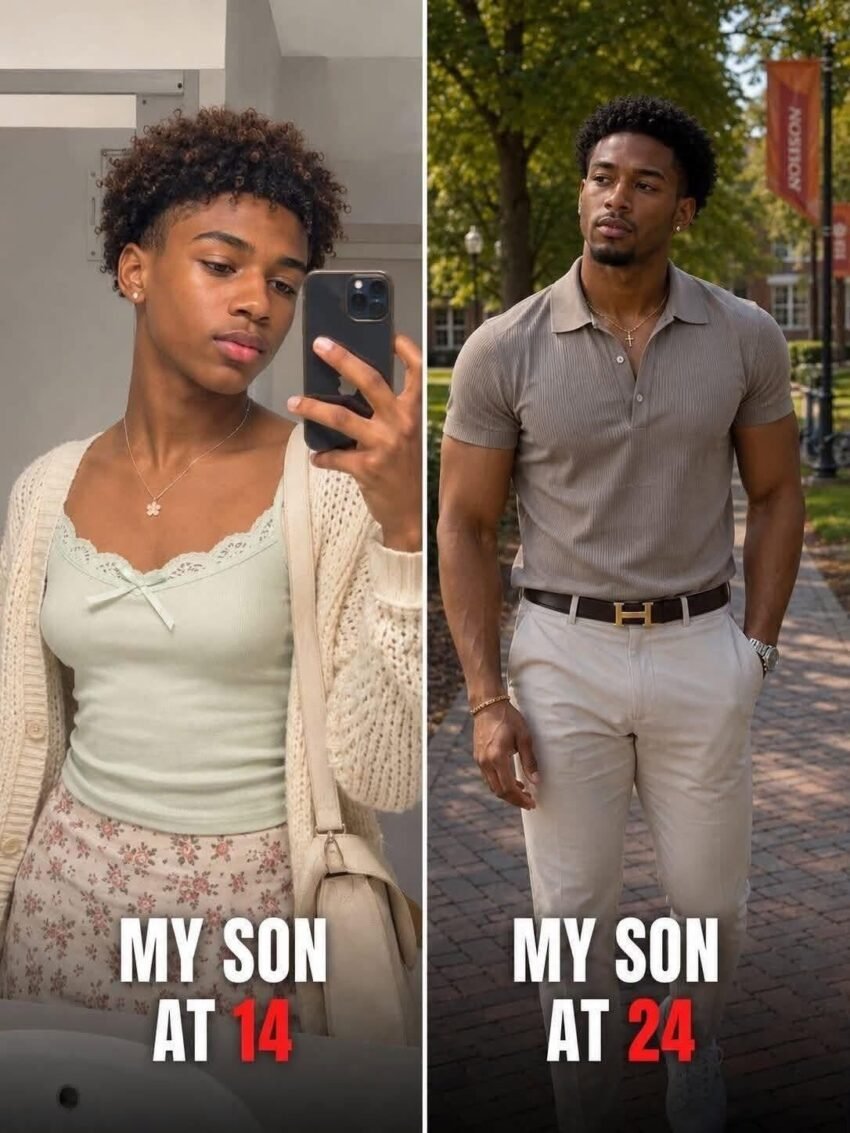
My Son Ran Away After His 18th Birthday—Six Years Later, He Returned and Said, “My Stepdad Has to Tell You the Truth”
Part 2
Then he pointed straight at my husband.
For a moment, the whole house went silent.
My son stood in the doorway with rainwater on his shoulders, a suitcase beside his feet, and six years of absence written across his face.
He was taller than I remembered.
Broader.
His hair was cut short now.
His jaw was sharper, his voice deeper, his expression harder.
But his eyes were the same.
My child’s eyes.
The same eyes that used to look at me from behind my bathroom mirror when he was twelve, terrified I would catch him touching my lipstick.
The same eyes that had begged me silently for protection every time my husband, Victor, said something cruel at dinner.
The same eyes that had disappeared from my life the night after his eighteenth birthday.
“Eli,” I whispered.
He flinched at the name.
Not because he hated it.
Because it still belonged to the version of him who had left this house broken.
Victor stood from the kitchen table slowly.
He looked older now, but still carried himself like a man waiting for someone to salute.
“What is this?” Victor asked.
My son did not look away.
“You know exactly what this is.”
I turned to my husband.
“Victor?”
His face was pale, but his voice stayed cold.
“I have no idea what he’s talking about.”
My son laughed once.
It was not a happy laugh.
“You’re still doing it.”
“Doing what?”
“Acting like if you say something calmly, it becomes true.”
I stepped forward.
“Eli, please. Where have you been? Are you okay? I looked for you for years.”
His jaw tightened.
“I know.”
The answer hit me strangely.
Not comforting.
Not accusing.
Just true.
“I looked,” I said again, because I needed him to believe it.
“I know, Mom.”
Mom.
The word nearly brought me to my knees.
For six years, I had imagined hearing it again.
In airports.
In grocery stores.
In dreams that left me waking up with a wet pillow.
I took another step toward him, but he raised his hand again.
“Not yet.”
The words stopped me.
Not yet.
Not no.
I held onto that.
Victor crossed his arms.
“You disappear for six years, then come back making accusations in my house?”
My son looked around the room.
“Your house?”
Victor’s mouth tightened.
“My home.”
“No,” my son said. “That was always your favorite lie.”
I looked between them.
“What is going on?”
My son reached into the inside pocket of his coat and pulled out a folded envelope.
It was old.
Soft at the corners.
He held it out to me.
My hands shook as I took it.
Across the front, in handwriting I recognized, was my name.
Mara.
My handwriting.
No.
Not mine.
Victor’s.
I looked up slowly.
“What is this?”
My son’s voice dropped.
“The note you found on my bed wasn’t the one I wrote.”
The room tilted.
“What?”
“The note that said I couldn’t live like that anymore? The one that made you think I left because I gave up?”
I nodded, barely breathing.
“That wasn’t mine.”
Victor’s face changed.
Only for a second.
But I saw it.
So did my son.
Eli stepped into the house and closed the door behind him.
“I wrote a different note.”
My fingers went numb around the envelope.
“What did it say?”
He looked at Victor.
“It said I was leaving because Victor gave me a choice.”
My heart began pounding.
“What choice?”
Victor barked, “This is ridiculous.”
My son’s eyes stayed on him.
“Tell her.”
Victor said nothing.
“Tell her what you told me in the garage after my birthday party.”
I turned toward my husband.
The garage.
I remembered that night.
The fight.
The cake left untouched.
My son going upstairs.
Victor saying he needed air.
Me cleaning dishes with shaking hands, telling myself we would fix it in the morning.
But there had been no morning.
Only an empty bed.
A missing backpack.
And a note that destroyed my life.
“What happened in the garage?” I asked.
Victor looked at me.
“Mara, he was emotional that night.”
My son’s voice sharpened.
“I was terrified.”
Victor pointed at him.
“You were out of control.”
“I was eighteen.”
“You were confused.”
“No,” my son said. “I was trapped.”
I unfolded the envelope.
Inside was a note.
Old paper.
Faded ink.
My son’s handwriting.
The handwriting I still had on birthday cards tucked into a box under my bed.
Mom,
I’m not leaving because I don’t love you. I’m leaving because Victor told me if I stay, he will make sure you lose the house. He said he has records, debts, and things you don’t know about. He said if I care about you, I’ll go quietly and never contact you.
My breath stopped.
I read the next line.
He said if I tell you, he’ll make it look like I’m unstable and dangerous.
The kitchen blurred.
I gripped the edge of the counter.
My son’s voice sounded far away.
“I left that note on my pillow.”
I looked up at Victor.
“You took it?”
Victor’s face hardened.
“I found it.”
“You took it?”
He looked away.
My son continued.
“He replaced it with one he wrote himself. One that made it sound like I hated you. Like I wanted to vanish. Like none of it was his fault.”
I could hear my own heartbeat.
For six years, I had kept that note in a drawer.
I had read it until the folds tore.
I had blamed myself.
I had blamed Victor.
Then I had blamed myself for blaming Victor.
And all that time, the words that shaped my grief had not even belonged to my child.
I looked at my husband.
“Tell me it isn’t true.”
Victor’s jaw clenched.
“Mara—”
“Tell me.”
He looked at my son with contempt.
“He was destroying this family.”
The words landed like a confession.
My knees almost gave out.
My son closed his eyes briefly, as if hearing it still hurt even after all these years.
Victor continued, angrier now.
“You were blind to what was happening. He was wearing women’s clothes, using makeup, embarrassing you, embarrassing himself. Someone had to make him face reality.”
“Reality?” I whispered.
“He needed discipline.”
My son laughed bitterly.
“There it is.”
Victor turned on him.
“And look at you now. Standing there dressed like a man. Strong. Serious. You think you proved me wrong? You proved me right.”
My son’s face went still.
For the first time, I saw pain flash beneath the anger.
Then he said quietly, “You still don’t understand.”
I looked at him.
He turned to me.
“Mom, I didn’t come back to show him I became what he wanted.”
My throat tightened.
“Then why?”
“Because I survived him.”
Victor scoffed.
“Oh, please.”
Eli looked at him.
“I wore men’s clothes today because I wanted to walk back into this house without giving you anything easy to attack. But what I wear now, what I wore then, who I was trying to understand when I was a teenager — none of it ever gave you the right to threaten me.”
I began to cry.
Quietly at first.
Then harder.
Because I remembered my child at twelve, hiding in my closet.
At fourteen, asking why liking certain clothes made people angry.
At sixteen, standing in the school hallway with red eyes after boys mocked him.
At eighteen, sitting at the birthday table while Victor told him he would never be respected unless he became “a real man.”
And I remembered myself.
Trying to soften everything.
“Victor just doesn’t understand.”
“He was raised differently.”
“He worries about you.”
“He’ll come around.”
But he never came around.
He circled tighter.
And I let him.
That truth hurt so badly I could barely stand.
“Why didn’t you call me?” I asked my son.
His face cracked.
“I tried.”
My breath caught.
“What?”
“I called from a bus station two days after I left.”
Victor looked down.
My son saw it and nodded.
“Tell her that part too.”
I stared at Victor.
“What did you do?”
Victor’s mouth twisted.
“He called the house while you were sleeping.”
“You spoke to him?”
Victor said nothing.
My son answered.
“He told me you didn’t want to hear from me. He said you had read my note and were done being humiliated. He said if I loved you, I would let you move on.”
A sound left me.
Not a sob.
Not a scream.
Something worse.
A mother’s body realizing she had been robbed of her child twice.
I lunged toward Victor, but not to strike him.
To get away from him.
“You answered that call?”
“Mara, he was manipulating you.”
“He was my son.”
“He was an adult.”
“He was my child.”
Victor slammed his hand onto the table.
“And I was your husband.”
The silence that followed was sharp.
My son looked at me.
This was the moment.