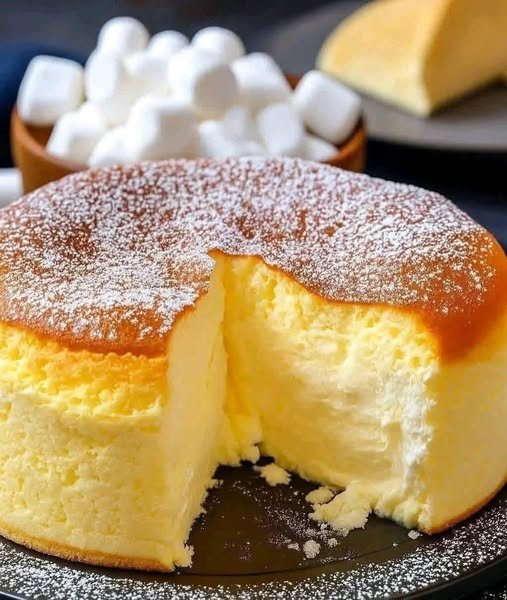
☁️🍰 Soufflé Fluffy Yogurt Cake — Light, Jiggly and Melt-in-Your-Mouth Soft!
This Soufflé Fluffy Yogurt Cake is unbelievably light, soft, airy, and delicate.
It has the gentle tang of yogurt, the cloud-like texture of a soufflé, and the smooth creaminess of a Japanese-style cheesecake—but without the heaviness of a traditional cheesecake.
The cake rises beautifully in the oven, develops a lightly golden top, and stays moist and tender inside. Each bite feels almost weightless and melts in your mouth.
It is perfect for brunch, afternoon tea, birthdays, Mother’s Day, spring gatherings, Sunday dessert, or any time you want an elegant homemade cake that is not overly sweet.
Serve it plain with powdered sugar or dress it up with berries, whipped cream, lemon curd, honey, or fruit sauce.
⏱️ Prep Time: 25 minutes
🔥 Bake Time: 55–65 minutes
❄️ Cooling Time: About 1 hour
🧊 Optional Chilling Time: 2 hours
🕒 Total Time: About 2½–4½ hours
🍽️ Servings: 8–10
🍰 Pan Size: 8-inch round cake pan
Ingredients
For the Yogurt Cake
- 1 cup full-fat plain Greek yogurt, room temperature
- 4 large eggs, separated and at room temperature
- ½ cup granulated sugar, divided
- 3 tablespoons unsalted butter, melted and slightly cooled
- ¼ cup whole milk, room temperature
- 1 teaspoon vanilla extract
- 1 teaspoon finely grated lemon zest, optional
- ⅓ cup cake flour
- 2 tablespoons cornstarch
- ¼ teaspoon kosher salt
- ½ teaspoon cream of tartar or 1 teaspoon fresh lemon juice
Optional Toppings
- Powdered sugar
- Fresh strawberries
- Blueberries
- Raspberries
- Whipped cream
- Honey
- Lemon curd
- Berry sauce
- Fresh mint
- Finely grated lemon zest
Important Ingredient Notes
Use Full-Fat Greek Yogurt
Full-fat Greek yogurt gives the cake a creamier texture and helps prevent excess moisture.
Regular plain yogurt can be used, but it should be strained first so the batter does not become too thin.
Use Room-Temperature Ingredients
Cold yogurt, eggs, or milk can cause the melted butter to solidify and make the batter harder to combine smoothly.
Remove the ingredients from the refrigerator approximately 30–45 minutes before baking.
Separate the Eggs Carefully
Do not allow any egg yolk to enter the egg whites.
Even a small amount of yolk or grease can prevent the whites from whipping properly.
Equipment Needed
- 8-inch round cake pan
- Large roasting pan
- Electric hand or stand mixer
- Two mixing bowls
- Fine-mesh sieve
- Rubber spatula
- Parchment paper
- Aluminum foil
- Wire cooling rack
Instructions
1. Prepare the Oven
Preheat your oven to 300°F.
Position the oven rack in the lower-middle section.
This lower baking temperature allows the cake to rise gradually and helps prevent the top from cracking too quickly.
2. Prepare the Cake Pan
Lightly grease the bottom and sides of an 8-inch round cake pan.
Line the bottom with parchment paper.
Cut a strip of parchment paper to line the sides, allowing it to rise approximately 1–2 inches above the rim of the pan.
The cake may rise above the edge while baking, so the taller parchment collar provides additional support.
3. Wrap the Pan
Wrap the outside of the cake pan tightly with two or three layers of heavy-duty aluminum foil.
This prevents water from leaking into the pan during the water-bath baking process.
A solid-bottom cake pan is easier to protect than a springform pan.
4. Separate the Eggs
Place the egg yolks in a large mixing bowl.
Place the egg whites in a separate clean, dry bowl.
Make sure the bowl used for the whites has no grease, moisture, or soap residue.
5. Prepare the Yogurt Mixture
Add the Greek yogurt to the egg yolks.
Whisk until smooth.
Add the melted butter slowly while whisking continuously.
Mix in the milk, vanilla extract, lemon zest, and salt.
Continue whisking until the mixture is completely smooth and evenly combined.
6. Sift the Dry Ingredients
Place the cake flour and cornstarch in a fine-mesh sieve.
Sift them directly over the yogurt mixture.
Whisk gently until no dry streaks remain.
Do not overmix.
The batter should be smooth, creamy, and slightly thick.
7. Begin Whipping the Egg Whites
Add the cream of tartar or lemon juice to the egg whites.
Beat on medium speed until the whites become foamy.
They should look like a bowl filled with small bubbles.
8. Add the Sugar Gradually
Slowly add the granulated sugar, approximately one tablespoon at a time, while continuing to beat.
Do not pour all the sugar in at once.
Gradual addition allows the sugar to dissolve and helps create a stable meringue.
9. Beat to Medium Peaks
Continue beating until medium peaks form.
When the beaters are lifted, the peak should stand but gently bend at the tip.
Avoid beating the egg whites until extremely stiff or dry.
Overbeaten whites are harder to fold into the batter and can cause large air pockets or cracking.
10. Fold in the First Portion of Meringue
Add approximately one-third of the whipped egg whites to the yogurt batter.
Use a whisk or rubber spatula to mix this first portion in more thoroughly.
This lightens the batter and makes the remaining meringue easier to fold.
11. Fold in the Remaining Meringue
Add half of the remaining egg whites.
Using a rubber spatula, cut through the center of the bowl, sweep along the bottom, and fold the batter over itself.
Rotate the bowl as you fold.
Add the final portion of egg whites and continue folding gently until no large white streaks remain.
Do not stir in circles or mix aggressively.
Overmixing removes the air that gives the cake its fluffy texture.
12. Pour the Batter into the Pan
Pour the batter into the prepared cake pan.
Smooth the top gently.
Tap the pan very lightly on the counter once or twice to release large air bubbles.
Do not tap repeatedly, as this can deflate the batter.
13. Prepare the Water Bath
Place the wrapped cake pan inside a large roasting pan.
Pour hot water into the roasting pan until it reaches approximately 1 inch up the sides of the cake pan.
The water should be hot but does not need to be boiling.
The water bath provides gentle, even heat and helps keep the cake moist.
14. Bake at Low Temperature
Carefully transfer the roasting pan to the oven.
Bake at 300°F for 45 minutes.
Do not open the oven during this stage.
A sudden temperature drop can cause the delicate cake to collapse.
15. Increase the Temperature Slightly
After 45 minutes, increase the oven temperature to 325°F.
Continue baking for another 10–20 minutes.
The cake is ready when:
- The top is lightly golden
- The center jiggles gently when the pan is moved
- The surface springs back lightly when touched
- A toothpick inserted near the center comes out mostly clean
- The cake does not appear wet or liquid
16. Turn Off the Oven
Turn off the oven.
Leave the cake inside with the door closed for approximately 10 minutes.
17. Cool Gradually
Open the oven door slightly and leave the cake inside for another 10–15 minutes.
Gradual cooling reduces the chance of sudden shrinking or cracking.
Some deflation is normal because this is a soufflé-style cake.
18. Remove from the Water Bath
Carefully lift the cake pan out of the roasting pan.
Remove the foil from the outside.
Place the cake on a wire cooling rack.
Let it cool in the pan for approximately 15 minutes.
19. Remove the Cake
Run a thin knife carefully around the edge when necessary.
Place a plate over the pan and invert the cake gently.
Remove the parchment paper, then flip the cake upright onto a serving plate.
Handle it carefully because the warm cake is extremely delicate.
20. Cool Completely
Let the cake cool completely before slicing.
For a slightly firmer, cheesecake-like texture, cover and refrigerate it for approximately 2 hours.
For the softest soufflé texture, serve it at room temperature.
21. Garnish and Serve
Dust the top lightly with powdered sugar.
Decorate with berries, whipped cream, lemon zest, honey, or fruit sauce.
Use a sharp, thin knife to slice the cake.
Wipe the blade between cuts for cleaner servings.
What Should the Texture Be Like?
A properly baked soufflé yogurt cake should be:
- Light and airy
- Soft and moist
- Slightly jiggly
- Delicate rather than crumbly
- Creamy without being wet
- Mildly tangy
- Less dense than cheesecake
- More tender than ordinary sponge cake
The cake may shrink slightly as it cools. This is normal for a soufflé-style dessert.
Tips for the Fluffiest Yogurt Cake
✅ Use room-temperature ingredients: They blend more smoothly.
✅ Keep the egg-white bowl completely clean: Grease prevents proper whipping.
✅ Add sugar gradually: This produces a more stable meringue.
✅ Stop at medium peaks: Extremely stiff whites are difficult to fold.
✅ Fold gently: Preserve as much air as possible.
✅ Use a water bath: It protects the delicate texture.
✅ Bake at a low temperature: Slow baking reduces cracking.
✅ Avoid opening the oven early: Sudden temperature changes can collapse the cake.
✅ Cool gradually: Do not remove it immediately from the hot oven.
✅ Expect slight shrinkage: A little deflation is natural.
Why Did My Cake Collapse?
Some shrinking is expected, but excessive collapse may be caused by:
- Underbaking
- Opening the oven too early
- Overbeating the egg whites
- Underbeating the egg whites
- Folding too aggressively
- Adding too much liquid
- Cooling too quickly
- Using a pan that was too large
- Removing the cake from the pan while extremely hot
Make sure the center is set before turning off the oven.
Why Did the Top Crack?
Possible causes include:
- The oven temperature was too high
- The cake was placed too close to the top heating element
- The water bath did not contain enough water
- The egg whites were overbeaten
- The cake rose too quickly
- The batter contained large air bubbles
A cracked cake is still delicious.
Cover the surface with powdered sugar, whipped cream, or fresh fruit.
Why Is My Cake Wet Inside?
The cake may be wet because:
- It was underbaked
- The yogurt contained too much liquid
- The flour was undermeasured
- The pan was too small or deep
- Too much milk was added
- The cake was sliced before cooling
Return an underbaked cake to a low oven when it is still warm.
When fully cooled, refrigerate it for several hours to help the texture firm.
Why Is My Cake Dense?
Common reasons include:
- The meringue was deflated during folding
- The egg whites were not whipped enough
- The batter was overmixed
- The flour was added without sifting
- The ingredients were too cold
- The cake sat too long before baking
Place the batter in the oven shortly after folding in the egg whites.
Why Is the Bottom Soggy?
A soggy bottom may be caused by water leaking through the foil.
Use a solid cake pan or wrap the outside securely with several layers of heavy-duty foil.
You can also place the cake pan inside a slightly larger pan before setting it in the water bath.
Lemon Soufflé Yogurt Cake
Add:
- 1 tablespoon finely grated lemon zest
- 1 tablespoon fresh lemon juice
- ½ teaspoon lemon extract, optional
Reduce the milk by 1 tablespoon when adding extra lemon juice.
Serve with lemon curd and whipped cream.
Orange Yogurt Cake
Add:
- 1 tablespoon orange zest
- ½ teaspoon orange extract
Serve with orange slices or a light orange glaze.
Vanilla Bean Yogurt Cake
Replace vanilla extract with:
- 1 teaspoon vanilla bean paste
The small vanilla seeds give the cake an elegant bakery-style appearance.
Berry Yogurt Cake
Serve the finished cake with:
- Strawberry sauce
- Blueberry compote
- Raspberry puree
- Mixed fresh berries
Avoid adding large amounts of fruit directly to the batter because excess moisture can affect the rise.
Chocolate Soufflé Yogurt Cake
Replace 2 tablespoons of cake flour with 2 tablespoons unsweetened cocoa powder.
Add:
- 2 ounces melted semisweet chocolate, cooled slightly
Fold the chocolate into the yogurt mixture before adding the meringue.
The chocolate version may be slightly denser.
Matcha Yogurt Cake
Replace 1 tablespoon cake flour with 1 tablespoon culinary-grade matcha powder.
Sift the matcha with the flour and cornstarch to prevent lumps.
Serve with powdered sugar or white chocolate sauce.
Coconut Yogurt Cake
Replace the whole milk with canned coconut milk.
Add:
- ½ teaspoon coconut extract
- Toasted coconut for garnish
Use full-fat canned coconut milk rather than refrigerated coconut beverage.
Can You Use Regular Yogurt?
Yes.
Place regular plain yogurt in a cheesecloth-lined strainer.
Let it drain in the refrigerator for approximately 1–2 hours.
Measure 1 cup after draining.
The texture should resemble Greek yogurt.
Can You Use Low-Fat Yogurt?
Low-fat Greek yogurt can work, but the cake may be slightly less creamy.
Fat-free yogurt is not recommended because it can create a drier or more rubbery texture.
Can You Use Flavored Yogurt?
Plain yogurt provides the most reliable texture.
Flavored yogurt may contain extra sugar, fruit, stabilizers, or liquid that changes the batter.
When using sweetened yogurt, reduce the granulated sugar slightly.
Can You Use All-Purpose Flour?
Yes.
Replace the cake flour with:
- ¼ cup plus 1 tablespoon all-purpose flour
The cake may be slightly less delicate.
For a softer texture, remove 1 tablespoon of the flour and replace it with additional cornstarch.
Gluten-Free Option
Use a cup-for-cup gluten-free baking flour blend in place of cake flour.
Choose a blend designed for cakes and containing xanthan gum.
The finished texture may vary slightly by brand.
Dairy-Free Option
A dairy-free version requires more adjustments.
You can experiment with:
- Thick dairy-free Greek-style yogurt
- Dairy-free butter
- Unsweetened oat or soy milk
Coconut yogurt may add stronger flavor and can vary greatly in thickness.
Because dairy-free products contain different stabilizers and moisture levels, the final rise may not be identical.
Individual Mini Cakes
Divide the batter among parchment-lined ramekins.
Place the ramekins in a water bath.
Bake at 300°F for approximately 25–35 minutes, depending on size.
Cool gradually.
Mini cakes are perfect for brunches, showers, and dinner parties.
Make-Ahead Instructions
Bake the cake one day before serving.
Cool it completely, cover it carefully, and refrigerate.
Bring it closer to room temperature for approximately 20 minutes before serving when you prefer a softer texture.
Add powdered sugar and fresh fruit shortly before serving.
Storage Instructions
Store the cake in an airtight container in the refrigerator for up to 4 days.
Because it contains eggs, yogurt, milk, and butter, do not leave it at room temperature for more than 2 hours.
The cake may become slightly firmer after refrigeration.
Can You Freeze Soufflé Yogurt Cake?
Freezing is possible, but the delicate texture may become slightly wetter or denser after thawing.
For the best quality, enjoy it fresh.
When freezing is necessary:
- Cool the cake completely.
- Cut it into individual slices.
- Wrap each slice tightly.
- Freeze for up to 1 month.
- Thaw overnight in the refrigerator.
What to Serve with Soufflé Yogurt Cake
Serve it with:
- Fresh strawberries
- Blueberries
- Raspberries
- Whipped cream
- Lemon curd
- Honey
- Berry sauce
- Vanilla ice cream
- Hot coffee
- Iced coffee
- Green tea
- Black tea
- Sparkling water with lemon
Simple Strawberry Sauce
Ingredients
- 2 cups chopped strawberries
- ¼ cup granulated sugar
- 1 tablespoon fresh lemon juice
- 1 teaspoon cornstarch
- 1 tablespoon water
Instructions
Add the strawberries, sugar, and lemon juice to a saucepan.
Cook over medium heat for approximately 5 minutes.
Mix the cornstarch and water in a small bowl.
Stir it into the strawberries.
Cook for another 1–2 minutes until lightly thickened.
Cool completely before serving with the cake.
Simple Lemon Glaze
Combine:
- 1 cup powdered sugar
- 2 tablespoons fresh lemon juice
- 1–2 teaspoons milk
Whisk until smooth.
Drizzle lightly over the cooled cake.
Do not add too much glaze, as this delicate cake is best with a light topping.
Why You’ll Love This Recipe
☁️ Light, airy, cloud-like texture
🥛 Creamy yogurt flavor
🍋 Fresh and lightly tangy
🍰 Less heavy than traditional cheesecake
✨ Elegant enough for celebrations
🫐 Delicious with fresh fruit
🧊 Easy to prepare ahead
☕ Perfect with coffee or tea
This Soufflé Fluffy Yogurt Cake is soft, delicate, lightly sweet, and almost weightless.
One gentle, melt-in-your-mouth bite—and it may become your new favorite way to turn simple yogurt into an unforgettable dessert!
📌 Save this recipe for brunch, birthdays, Mother’s Day, or your next family gathering.
👇 Would you top yours with powdered sugar, strawberries, lemon curd, honey, or whipped cream? Tell us in the comments!
#SouffleYogurtCake #FluffyYogurtCake #JapaneseStyleCake #YogurtCake #CloudCake #LightDessert #HomemadeCake #BakingFromScratch #BrunchDessert #SpringDesserts #CreamyCake #CakeRecipe #ElegantDesserts #FamilyRecipes #RecipeOfTheDay